
Asset Lifecycle Management Market Overview
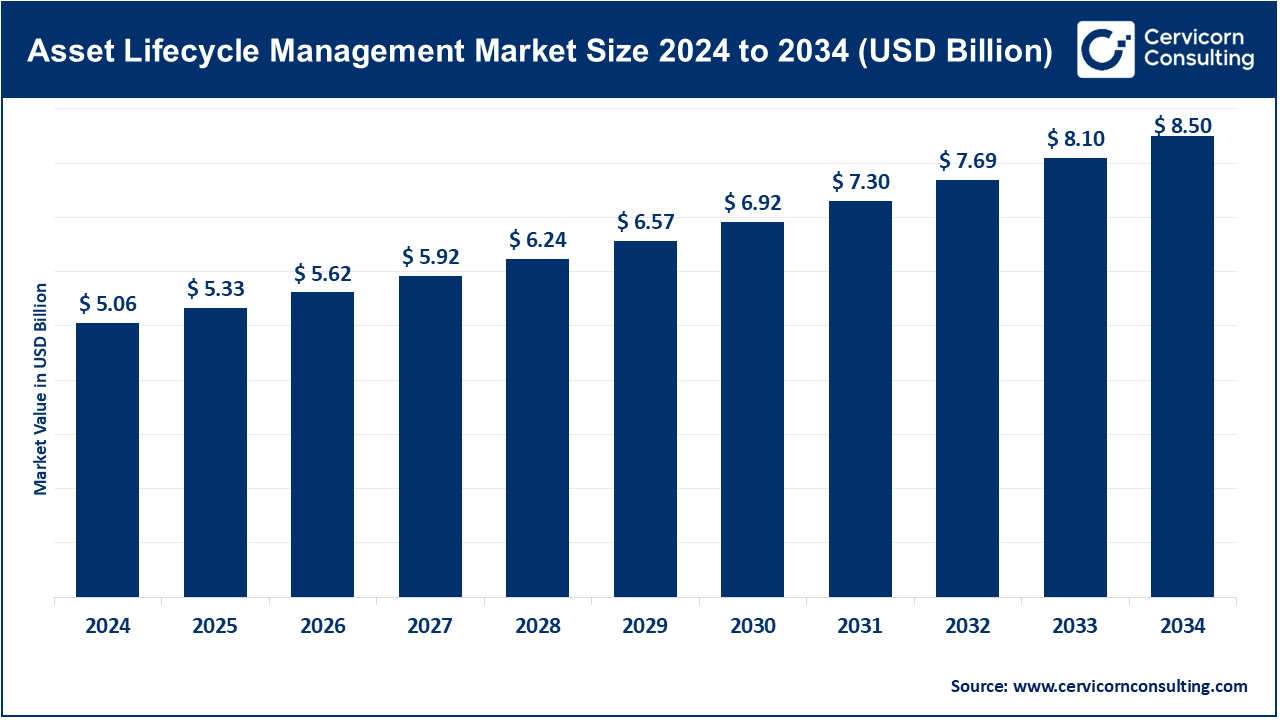
The global asset lifecycle management market reached a valuation of USD 5.06 billion in 2024 and is anticipated to rise to nearly USD 8.50 billion by 2034, progressing at a CAGR of 5.32% during the forecast period. ALM refers to the complete oversight of an organization’s physical assets—from procurement and installation to operation, maintenance, and end-of-life disposal. Modern ALM platforms leverage advanced technologies such as IoT connectivity, AI-driven analytics, predictive maintenance tools, and digital twin simulation models to extend asset life, boost operational reliability, and reduce maintenance costs.
The shift toward cloud-enabled ALM systems is accelerating due to their scalability, real-time data access, and ability to support strategic decision-making. Key industries including manufacturing, energy and utilities, transportation, healthcare, and IT are increasingly deploying ALM solutions to improve productivity, enhance sustainability efforts, and meet stringent compliance standards.
Get a Free Sample: https://www.cervicornconsulting.com/sample/2411
Key Market Trends
IoT-Based Predictive Maintenance
Businesses are rapidly integrating IoT sensors to continuously track asset performance. Predictive maintenance enabled by IoT can lower unplanned downtime by 20–50%, helping organizations address issues before they escalate.
Surging Adoption of Cloud-Hosted ALM
Cloud-based ALM platforms are expanding at an annual growth rate of 30%, supported by demand for scalable, real-time asset visibility and reduced dependency on onsite IT infrastructure.
AI and Digital Twin Technologies
AI algorithms and digital twin models provide a virtual representation of physical assets, enabling simulation, fault detection, and lifecycle optimization. More than 60% of manufacturing organizations now rely on AI-supported ALM systems to improve operational workflows.
Integration with Industrial Automation
As industries adopt automation at a rapid pace, ALM is becoming central to industrial operation systems, enhancing process efficiency and improving coordination with enterprise platforms such as ERP and MES.
Sustainability and Compliance-Focused Asset Management
Increasing environmental standards and ESG mandates are pushing companies to adopt ALM solutions that monitor resource consumption, emissions, and responsible end-of-life disposal. Businesses adopting ALM for sustainability achieve 15–40% cost reductions through optimized asset utilization.
Market Drivers
-
Growth of Industrial Automation: The rise of automated equipment across manufacturing, logistics, and energy has heightened the need for advanced asset tracking and management tools.
-
IoT & AI Integration: Smart sensors and AI-based insights significantly improve asset reliability and cut maintenance expenditure.
-
Operational Efficiency Priorities: Organizations report 10–30% enhancements in asset productivity and reduced ownership costs through ALM implementation.
-
Shift Toward Cloud Platforms: Cloud ALM offers rapid deployment, better scalability, and lower maintenance costs, attracting both large enterprises and SMEs.
-
Government Policies & Compliance: Global initiatives promoting digital transformation, sustainability, and infrastructure modernization are accelerating the adoption of ALM across sectors.
Impact of Trends and Drivers
-
Industry Impact: Manufacturing, energy, transport, and healthcare industries are seeing the greatest benefits, particularly from predictive maintenance and digital twin adoption, resulting in longer asset lifecycles and reduced disruptions.
-
Regional Impact: The Asia-Pacific region dominated the market with 48.3% revenue share in 2024, fueled by rapid industrial expansion and modernization efforts. North America accounted for 25.8%, driven by advanced digital adoption and stringent compliance frameworks.
-
Solution Impact: Cloud-based ALM systems are becoming the preferred choice due to real-time analytics capabilities, while on-premise systems continue to serve highly regulated sectors requiring strict data control.
Challenges & Opportunities
Challenges
-
Significant upfront investment required for advanced ALM technologies
-
Interoperability challenges when integrating with older legacy systems
-
Increased cybersecurity risks associated with IoT devices and cloud deployments
Opportunities
-
Expansion across emerging economies undergoing digital and industrial transformation
-
Enhanced ALM capabilities through AI, ML, and predictive analytics
-
Growing corporate commitments to sustainability and ESG compliance
Future Outlook
The ALM market is projected to advance steadily at a CAGR of 5.32% from 2025 to 2034, ultimately reaching USD 8.50 billion by 2034. The increasing integration of AI and digital twins, combined with widespread cloud adoption and sustainability-driven asset strategies, will continue to shape market growth. As organizations across manufacturing, energy, healthcare, and transportation prioritize operational optimization and regulatory compliance, investment in modern ALM solutions is expected to accelerate.
To Get Detailed Overview, Contact Us:
https://www.cervicornconsulting.com/contact-us