
Market Overview
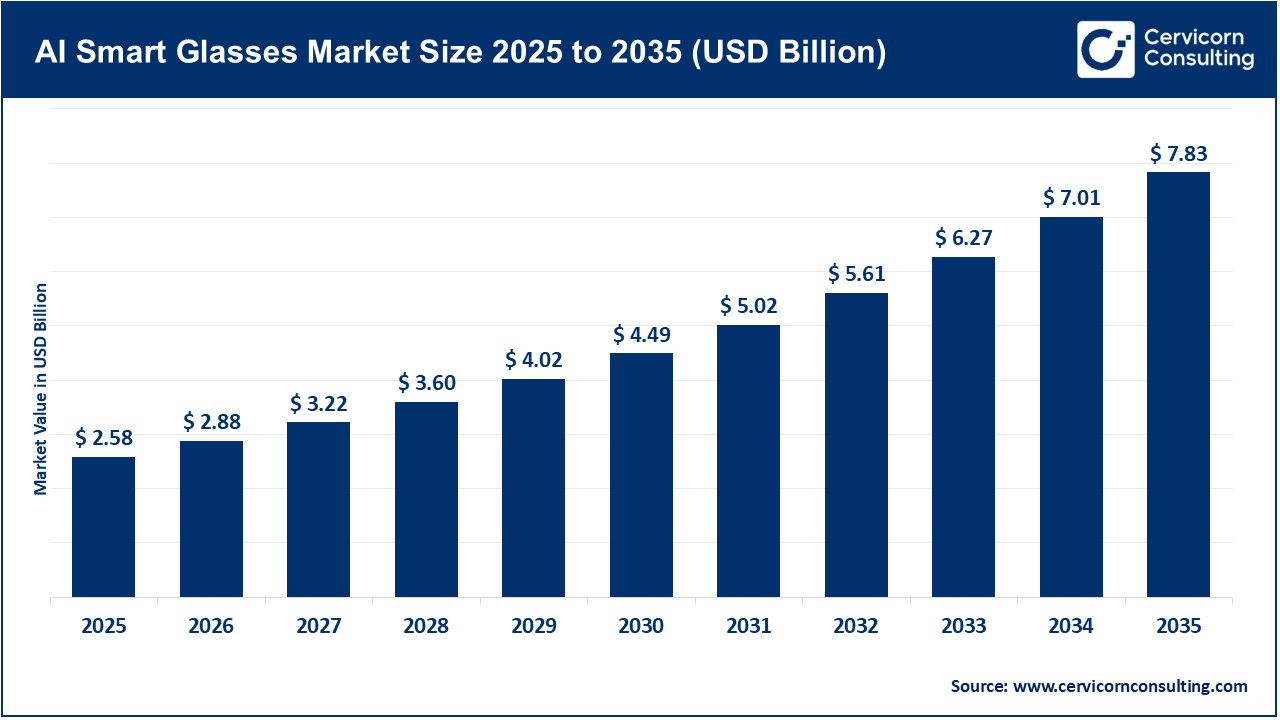
The AI smart glasses market has emerged as one of the most transformative segments in the wearable technology industry, merging artificial intelligence (AI), augmented reality (AR), and advanced optical engineering into compact, hands-free computing devices. Valued at USD 2.58 billion in 2025, the market is projected to reach around USD 7.83 billion by 2035, growing at a compound annual growth rate (CAGR) of 11.74% between 2026 and 2035.
This rapid expansion reflects the escalating adoption of smart glasses across consumer and enterprise environments, as they evolve from niche gadgets into powerful AI-driven systems capable of real-time data visualization, contextual computing, and multilingual translation.
👉 Get a Free Sample: https://www.cervicornconsulting.com/sample/2804
Key Market Trends
1. Rise of On-Device AI and AR Integration
AI smart glasses are evolving from simple connected devices into autonomous systems capable of executing complex tasks locally. By integrating AI processors and AR-enabled displays, these glasses now support real-time scene analysis, visual overlays, and instant translation without relying heavily on cloud services. The combination of miniaturized optics, embedded AI, and enhanced processing power has made them increasingly suitable for professional and everyday use.
2. Accelerating Enterprise Adoption
Industrial sectors including manufacturing, logistics, field operations, and healthcare are rapidly implementing AI smart glasses to streamline workflows, improve worker safety, and boost efficiency. The enterprise segment accounts for more than 40% of total demand, driven by applications such as remote technical support, live data visualization, and hands-free maintenance guidance. In healthcare, surgeons and clinicians are using these glasses to access real-time data, enhancing precision and situational awareness.
3. Collaboration Between Tech and Fashion
The boundary between fashion and technology is blurring as companies collaborate to make smart eyewear stylish and functional. Partnerships such as Meta and Ray-Ban have redefined public perception of wearable AI, combining high-end aesthetics with intelligent features. This synergy between fashion appeal and digital functionality has made AI eyewear more socially acceptable and desirable for mainstream users.
4. Breakthroughs in Connectivity and Chip Design
Advancements in wearable processors, edge AI, and next-generation 5G/6G networks are driving significant market progress. Modern AI chipsets now deliver faster, energy-efficient performance directly on the device, while advanced connectivity enables real-time AR experiences, low-latency streaming, and instant cloud synchronization. These developments are laying the foundation for scalable enterprise and entertainment applications.
5. Strengthened Focus on Privacy and Security
As smart glasses increasingly feature cameras, microphones, and biometric sensors, privacy has become a central design consideration. Manufacturers are incorporating data encryption, on-device AI processing, and anonymization protocols to comply with global standards. This focus on ethical AI and data security helps foster long-term consumer confidence and regulatory compliance.
Market Drivers
1. Expanding AR and Digital Transformation Initiatives
Organizations worldwide are investing in augmented and mixed reality to enhance workforce training, process monitoring, and asset management. Companies adopting AR-enabled systems have reported up to 10% gains in productivity, underscoring the tangible return on investment offered by AI-powered eyewear. These efficiency benefits are accelerating enterprise-level adoption globally.
2. Surge in Smart Glass Shipments
In the first half of 2025, global smart glass shipments grew by over 110% year-on-year, with AI-integrated models comprising nearly 80% of total shipments. This growth highlights a surge in both awareness and consumer appetite for wearable devices that deliver hands-free information access and context-aware intelligence.
3. Improved Affordability Through Technological Maturity
Progress in micro-display fabrication, miniaturized sensors, and wearable AI chips has resulted in significant cost reductions and performance enhancements. As devices become lighter, more efficient, and cost-effective, smart eyewear is becoming accessible to a broader demographic—fueling global adoption.
4. Growing Demand for Immersive, Hands-Free Interaction
Consumers increasingly favor intuitive devices that allow gesture or voice control without constant smartphone dependency. AI smart glasses cater to this need through AR overlays, virtual assistants, and instant translation capabilities, delivering an immersive experience that enhances both convenience and connectivity.
5. Government and Industry Support
National initiatives promoting AI innovation, digital transformation, and broadband infrastructure expansion are further propelling the market. Policies in regions such as North America, Europe, China, Japan, and India are fostering R&D investment and local manufacturing, reinforcing supply chains and encouraging the adoption of wearable technologies.
Impact of Trends and Drivers
-
Enterprise vs. Consumer Growth:
The enterprise segment currently leads the market due to its applications in industrial and healthcare operations, while the consumer segment is rapidly expanding with lifestyle, gaming, and entertainment-oriented products. -
Regional Momentum:
North America dominates in innovation and early technology adoption. Meanwhile, Asia-Pacific is emerging as the fastest-growing region, driven by large-scale production, favorable government policies, and lower component costs. -
Sectoral Opportunities:
Industries like logistics, automotive, and energy are using AI smart glasses for real-time diagnostics and quality assurance. Simultaneously, education and retail sectors are adopting them for immersive learning and interactive shopping experiences.
Challenges and Opportunities
Challenges
-
Cost and Battery Constraints:
Despite technological advances, smart glasses remain expensive—typically priced between USD 500 and USD 3,000. Limited battery life (2–5 hours) also restricts continuous industrial use, posing challenges for extended operations. -
Data Privacy Concerns:
The integration of high-resolution cameras and voice capture technologies raises ethical and legal questions regarding data collection, making compliance with regional regulations essential for manufacturers.
Opportunities
-
Recurring Software and AI Service Revenue:
Beyond hardware, many companies are leveraging AI analytics platforms, remote collaboration tools, and subscription-based AR content, generating recurring revenue and deeper customer engagement. -
Integration with IoT and Digital Twin Ecosystems:
AI eyewear is increasingly being connected to Industrial IoT frameworks, enabling predictive maintenance, remote diagnostics, and real-time equipment visualization. -
Mainstream Consumer Adoption:
As designs become sleeker and costs decline, AI smart glasses are positioned to become the next-generation personal computing interface, bridging fashion, utility, and immersive interaction.
Future Outlook
The AI smart glasses market is expected to maintain strong momentum, rising from USD 2.58 billion in 2025 to USD 7.83 billion by 2035, at a projected CAGR of 11.74%. While enterprise demand will remain a primary revenue driver in the near term, consumer adoption—propelled by entertainment, lifestyle, and fashion integration—will define the next wave of growth.
Ongoing innovations in AI-on-chip processing, battery optimization, and optical displays are anticipated to overcome current limitations, ushering in a new era of ubiquitous intelligent eyewear that seamlessly blends the digital and physical worlds.
Analyst Insights
To sustain growth and strengthen market presence, leading manufacturers should:
-
Focus on low-power AI chipsets and ergonomic product design.
-
Build comprehensive software ecosystems for added value.
-
Implement privacy-first frameworks for user data protection.
-
Collaborate with fashion and lifestyle brands to expand consumer reach.
These strategies are expected to shape competitive differentiation and long-term success in the evolving global AI smart glasses market.
👉 To Get Detailed Overview, Contact Us: https://www.cervicornconsulting.com/contact-us