
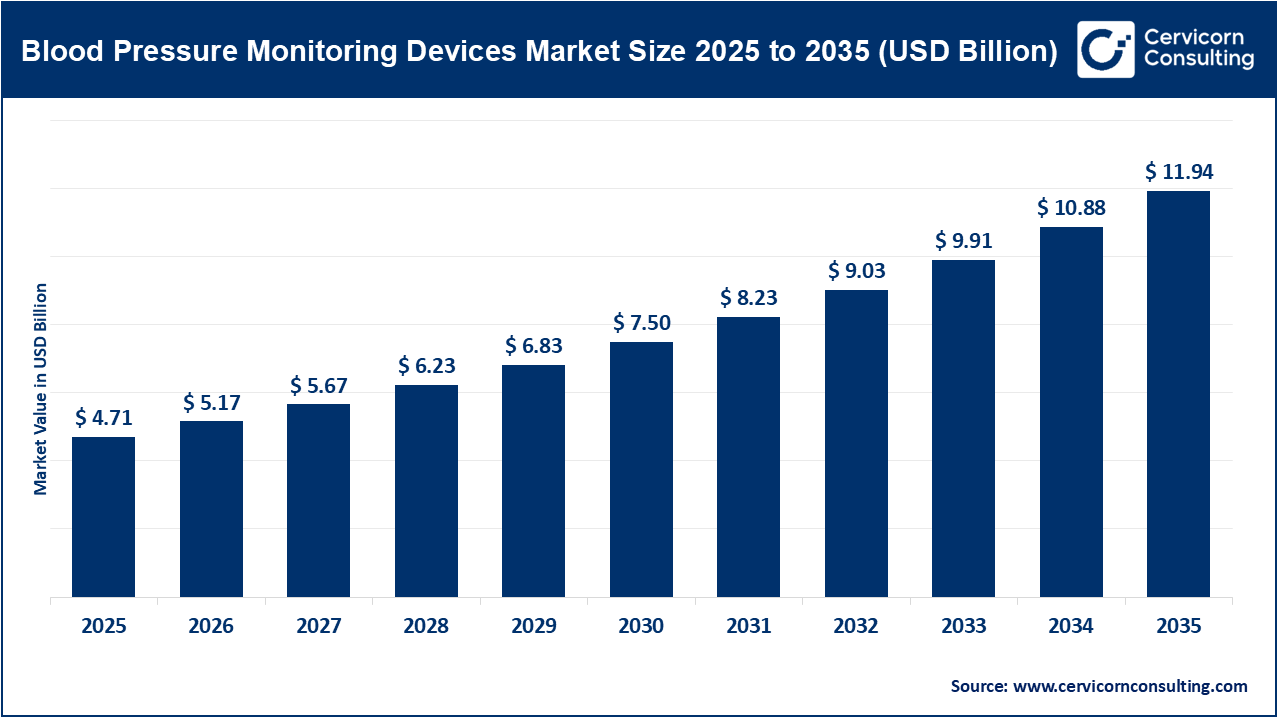
Blood Pressure Monitoring Devices Market Size
The blood pressure monitoring devices market was valued at approximately USD 4.71 billion in 2024 and is projected to grow significantly, reaching around USD 11.94 billion by 2035, reflecting a strong compound annual growth rate (CAGR) of 9.7% during the forecast period.
Market Overview
The global blood pressure monitoring devices market continues to witness strong growth as healthcare systems increasingly emphasize preventive care and chronic disease management. The market is expanding steadily, supported by the rising prevalence of hypertension, growing patient awareness, and continuous advancements in diagnostic technologies.
Blood pressure monitoring devices now play a critical role across clinical, home, and remote healthcare environments. The market encompasses a wide range of products, including automated digital monitors, ambulatory blood pressure monitors (ABPM), wearable monitoring devices, and connected smart blood pressure systems. Demand is being driven not only by hospitals and clinics but also by consumers seeking convenient and reliable self-monitoring solutions.
The sustained expansion of this market reflects long-term structural changes in healthcare delivery, where monitoring and early detection are becoming central to disease management strategies.
Get a Free Sample: https://www.cervicornconsulting.com/sample/2898
Key Market Trends
Several transformative trends are shaping the evolution of the blood pressure monitoring devices market.
Rise of Digital & Connected Monitoring Devices
Automated digital blood pressure monitors continue to replace traditional manual devices. These systems offer enhanced accuracy, ease of use, and seamless integration with digital health platforms. Connected devices capable of transmitting patient data through Bluetooth or Wi-Fi are becoming increasingly common, particularly in markets where remote patient monitoring is widely adopted.
Growth of Wearable & Cuffless Technologies
Wearable and cuffless blood pressure monitoring technologies are emerging as one of the most dynamic areas of innovation. Consumers are showing growing interest in continuous, non-invasive monitoring solutions embedded in smartwatches and fitness devices. These technologies improve user convenience while enabling more frequent measurements.
Integration with Remote Patient Monitoring Systems
Healthcare providers are increasingly integrating blood pressure devices into telehealth and remote care ecosystems. Devices capable of real-time data sharing allow clinicians to monitor chronic conditions more effectively, reducing the need for frequent in-person consultations and enabling proactive intervention.
AI & Advanced Analytics Adoption
Artificial intelligence and predictive analytics are becoming key differentiators. Modern monitoring platforms now offer features such as automated risk detection, trend analysis, and personalized insights. These capabilities enhance clinical decision-making and patient self-management.
Expansion of Home-Based Monitoring
Home-use blood pressure monitoring devices represent one of the fastest-growing segments. The shift toward domiciliary care, combined with increasing consumer health awareness, is driving widespread adoption. These devices are no longer viewed solely as convenience tools but as essential components of long-term hypertension management.
Market Drivers
Multiple structural drivers are fueling market growth.
Rising Prevalence of Hypertension
Hypertension remains one of the most widespread chronic conditions globally. The increasing burden of cardiovascular diseases is generating sustained demand for accurate and accessible monitoring solutions. Regular blood pressure measurement is now recognized as fundamental to preventive healthcare.
Technological Advancements
Continuous innovation in sensor technologies, device miniaturization, wireless connectivity, and AI integration is accelerating device adoption. A significant proportion of newly launched devices now include smart connectivity features, improving usability and enabling digital health integration.
Growth of Telehealth & Remote Care
The expansion of telemedicine and remote patient monitoring programs has significantly increased the relevance of connected blood pressure devices. Healthcare providers are leveraging these technologies to improve chronic disease management, enhance patient adherence, and reduce healthcare costs.
Increasing Consumer Awareness
Consumers are becoming more proactive in managing their health. Growing awareness of hypertension risks, coupled with rising adoption of digital health tools, is expanding the user base for home monitoring devices. Self-monitoring is increasingly embedded in everyday health routines.
Aging Global Population
Demographic shifts toward older populations are contributing to long-term demand growth. Elderly individuals are more susceptible to hypertension and cardiovascular disorders, making blood pressure monitoring devices essential for routine health assessment.
Impact of Trends and Drivers
The combined effect of market trends and drivers is reshaping competitive dynamics and demand distribution.
- Product Evolution: Digital, automated, and connected devices now dominate the market landscape. Wearable and cuffless technologies represent the fastest-growing innovation segment.
- End-User Expansion: While hospitals and clinics remain key revenue contributors, home healthcare is emerging as a primary growth engine. Consumer-driven demand is significantly influencing product development strategies.
- Regional Dynamics: Developed markets benefit from advanced healthcare infrastructure and high digital health adoption, while emerging economies are experiencing accelerated growth due to rising disease prevalence and improving healthcare access.
- Technology Integration: Ecosystem-based solutions integrating monitoring devices with mobile applications, analytics platforms, and remote care systems are becoming central to competitive positioning.
Challenges & Opportunities
Challenges
Despite strong growth, the market faces several constraints:
- Advanced monitoring technologies often involve higher costs, which may limit adoption in price-sensitive regions.
- Regulatory compliance requirements for medical-grade accuracy and data security can extend product development timelines.
- Device commoditization is intensifying price competition, pressuring manufacturer margins.
Opportunities
Simultaneously, significant growth opportunities are emerging:
- AI-enabled monitoring platforms offer strong differentiation potential.
- Wearable and continuous monitoring technologies present major expansion avenues.
- Emerging markets provide substantial untapped demand.
- Subscription-based and remote monitoring services are creating new revenue models.
Future Outlook
The blood pressure monitoring devices market is expected to maintain strong growth momentum over the coming decade. Expansion will be primarily driven by digital transformation in healthcare, rising chronic disease prevalence, and increasing consumer adoption of connected health technologies.
Future competitive advantage will increasingly depend on:
- Integration with remote healthcare ecosystems
- AI-driven clinical intelligence
- Enhanced user experience and device convenience
- Scalable, cloud-connected monitoring platforms
As healthcare delivery continues to evolve, blood pressure monitoring devices will transition from standalone diagnostic tools to integral components of continuous health management systems.
To Get Detailed Overview, Contact Us: https://www.cervicornconsulting.com/contact-us