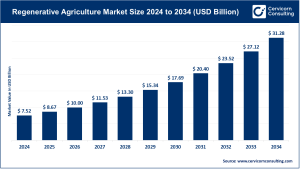
Market Overview
The global carbon farming market is emerging as a pivotal solution in the fight against climate change, harnessing agriculture and land management practices to capture and store carbon dioxide. In 2024, the market was valued at approximately USD 561 million and is anticipated to grow to around USD 2,175 million by 2034, reflecting a CAGR of 14.51%. Carbon farming combines regenerative agriculture, soil carbon sequestration, and nature-based strategies, creating financial incentives for farmers while supporting corporate and governmental sustainability objectives.
Key Market Trends
1. Advanced MRV (Measurement, Reporting, and Verification) Systems
MRV tools are becoming increasingly sophisticated, incorporating satellite imagery, AI-based soil analytics, and blockchain-enabled tracking to measure carbon sequestration more accurately. Platforms like Indigo Ag and Agreena exemplify this trend, providing transparency and credibility to soil carbon credit programs.
2. Expansion of Voluntary Carbon Markets (VCMs)
As corporations pursue net-zero targets, the purchase of carbon credits from carbon farming projects is growing. Increased corporate engagement in VCMs incentivizes farmers to adopt regenerative practices and participate in verified carbon credit schemes.
3. Government Policies and Incentives
Global governments are supporting carbon farming through grants, subsidies, and tax incentives. Initiatives such as the US Department of Agriculture’s Climate Smart Agriculture programs and the EU’s Farm to Fork Strategy encourage regenerative soil management and carbon sequestration practices.
4. Integration with ESG and Corporate Sustainability
Companies are embedding carbon farming into their Environmental, Social, and Governance (ESG) strategies, driving demand for high-quality, verifiable carbon credits. This trend positions carbon farming as a valuable revenue source for farmers while enhancing corporate sustainability credentials.
5. Rising Consumer Awareness and Demand for Sustainable Products
Consumers increasingly prefer products that are sustainably sourced and climate-positive. Industries such as food and beverage, textiles, and agriculture are responding by investing in carbon farming initiatives as part of their supply chain sustainability efforts.
Get a Free Sample: https://www.cervicornconsulting.com/sample/2606
Market Drivers
-
Increasing Demand for Carbon Credits: Corporate commitments to net-zero goals are fueling demand for verified carbon credits. Voluntary carbon markets are projected to exceed USD 50 billion by 2030, benefiting carbon farming initiatives.
-
Technological Innovations: Advanced soil carbon measurement tools, precision agriculture, and drone-enabled reforestation are reducing costs and improving carbon capture efficiency, enabling adoption across smallholder and large-scale farms.
-
Government and Policy Support: Incentives such as carbon subsidies, payments for ecosystem services, and regenerative agriculture grants promote wider farmer participation and investment.
-
Revenue Diversification for Farmers: Carbon farming offers farmers additional income through the sale of carbon credits, decreasing reliance on conventional crop revenue and enhancing long-term economic sustainability.
Impact of Trends and Drivers
-
Soil Carbon Projects: Expansion is concentrated in North America and Europe, where government support and corporate demand are strongest.
-
Reforestation and Agroforestry Projects: Growing in Africa, South America, and Southeast Asia, leveraging degraded land for carbon sequestration.
-
Technology-Driven Market Players: Platforms focused on digital MRV and carbon credit marketplaces are enhancing transparency, investor confidence, and scalability.
Challenges & Opportunities
Challenges:
-
Complex MRV procedures and high verification costs may discourage participation from smallholder farmers.
-
Carbon credit price volatility in voluntary markets creates uncertainty for long-term investments.
Opportunities:
-
Integration of blockchain and AI for transparent carbon accounting opens new business models.
-
Expanding carbon farming in emerging markets with marginal or degraded land can significantly enhance sequestration capacity.
-
Corporate partnerships provide opportunities for inclusive, large-scale carbon projects involving local farmers.
Future Outlook
The carbon farming market is expected to sustain robust growth, achieving a CAGR of 14.51% from 2025 to 2034, and potentially surpassing USD 2,175 million by 2034. Growth will be fueled by continuous technological innovation, supportive government policies, and increasing corporate and consumer demand for sustainable, climate-positive solutions. Emerging models, such as hybrid carbon removal strategies combining direct air capture with nature-based solutions, are likely to create new market segments and global investment opportunities.
To Get Detailed Overview, Contact Us: https://www.cervicornconsulting.com/contact-us