Market Overview
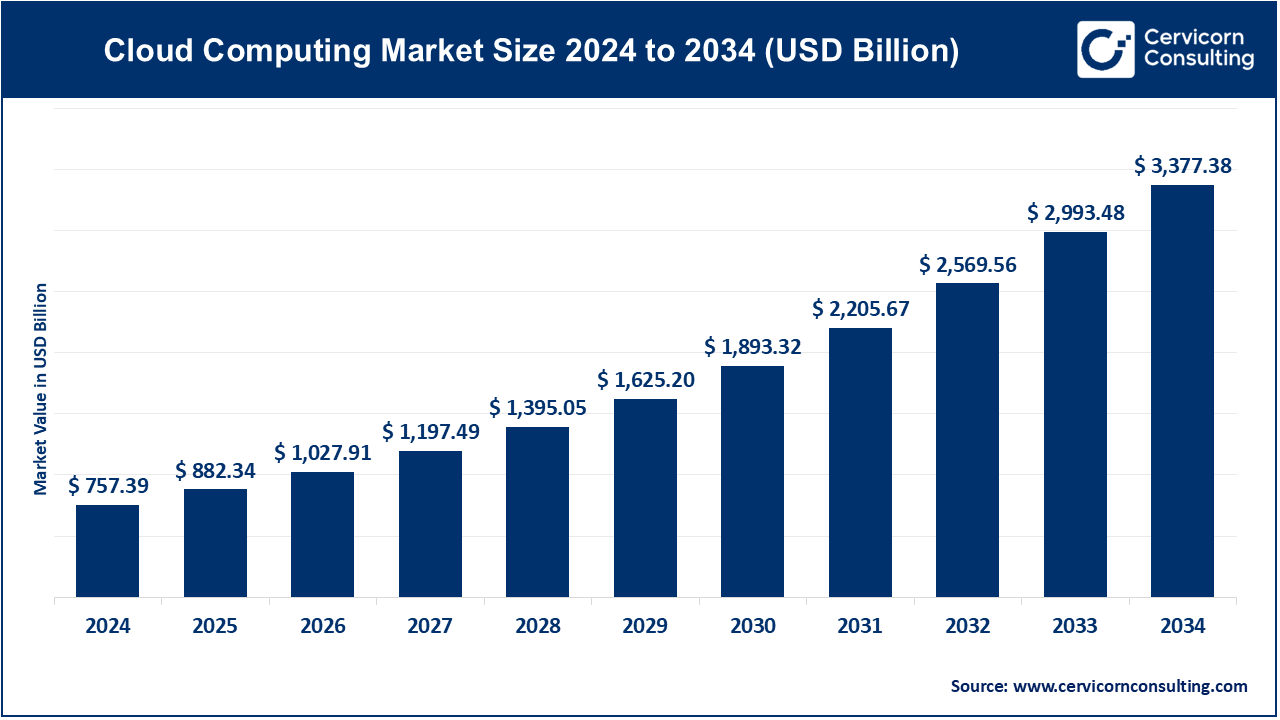
The global cloud computing market was valued at nearly USD 757.39 billion in 2024 and is anticipated to exceed USD 3,377.38 billion by 2034, expanding at an impressive CAGR of 16.12% between 2025 and 2034. This rapid expansion underscores the accelerating shift toward cloud-based technologies across every major sector. Cloud computing allows organizations to remotely access essential IT resources—such as data storage, processing capabilities, and software tools—while maintaining high scalability, operational agility, and cost efficiency.
The market is broadly segmented into Infrastructure as a Service (IaaS), Platform as a Service (PaaS), and Software as a Service (SaaS), with emerging segments like serverless architectures and distributed edge cloud systems becoming increasingly important. Industry-leading providers such as AWS, Microsoft Azure, and Google Cloud continue to dominate the competitive landscape through aggressive global expansion and continuous innovation.
Get a Free Sample: https://www.cervicornconsulting.com/sample/2414
Key Market Trends
AI-Powered Cloud Infrastructure
Cloud ecosystems are increasingly serving as foundational platforms for generative AI, machine learning, and advanced analytics. Major investments—such as AWS’s USD 11 billion AI cloud expansion in Georgia and Microsoft’s USD 3 billion AI-focused cloud investment in India—illustrate the growing emphasis on AI-integrated cloud environments. These technologies enhance enterprise operations by enabling predictive insights, automation, and personalized customer engagement.
Growing Adoption of Hybrid and Multi-Cloud Models
More enterprises are turning to hybrid and multi-cloud setups to balance security, flexibility, and cost efficiency. Adoption rates are particularly strong among public-sector and healthcare institutions, with 52% of federal organizations and 70% of public healthcare providers opting for hybrid-cloud approaches.
Widespread Enterprise Cloud Utilization
Cloud adoption has reached near saturation, with over 94% of large enterprises deploying cloud technologies and more than half planning additional workload migrations within the coming year. This widespread transition supports faster innovation cycles and enhances digital transformation initiatives.
Strengthening Export Capabilities and Global Connectivity
Organizations that utilize cloud platforms demonstrate higher engagement in global trade, even when operating outside major cities. This underscores the cloud’s role in enabling cross-border business scalability.
Rapid Expansion of Edge Computing
Cloud providers continue to roll out extensive edge computing networks to support latency-sensitive applications—such as IoT, streaming platforms, and gaming services. These localized compute resources enable real-time analytics and improve user experiences across distributed regions.
Market Drivers
Acceleration of Digital Transformation
Across industries, companies are upgrading their IT infrastructure by adopting cloud-native technologies, including microservices, container orchestration, and serverless systems. This shift supports faster development cycles and scalable innovation, significantly contributing to market momentum.
Rising Need for AI and Data-Heavy Computing
More than 65% of enterprises deploy AI and machine learning workloads in cloud environments. Cloud platforms provide scalable, GPU-enabled infrastructure essential for data modeling, automation, and advanced analytics.
Supportive Government Policies and National Cloud Initiatives
Governments worldwide are promoting cloud-first strategies, data center infrastructure, sovereign cloud frameworks, and regulatory protections. This boosts hybrid-cloud adoption in public services and ensures secure, compliant cloud operations.
Remote and Hybrid Workplace Expansion
The global shift toward remote and hybrid work creates demand for cloud-hosted collaboration tools, communication services, and productivity platforms. SaaS adoption remains high, with over 85% of small and medium-sized enterprises relying on cloud-based applications.
Enhanced Connectivity and Improved Cybersecurity
Advancements in network infrastructure, global broadband expansion, and cloud-native security solutions minimize operational risks. Cloud platforms offer integrated security features, automated backups, and disaster recovery capabilities, making them an attractive alternative to traditional IT setups.
Impact of Trends and Drivers
-
By Industry:
Sectors such as BFSI, IT & telecommunications, healthcare, and government lead cloud adoption due to their heavy reliance on analytics, secure data storage, and AI-driven operations. The BFSI industry alone contributed 25.6% of total market revenue in 2024. -
By Region:
North America remains dominant with 40.4% market share, followed by Europe at 28.3%, driven by well-established infrastructure and robust regulatory frameworks. Rapid growth is seen across Asia-Pacific and MEA, fuelled by digital transformation and booming e-commerce ecosystems. -
By Deployment Mode:
Private cloud solutions accounted for 47.2% of global revenue in 2024, reflecting strong demand for secure, compliant environments among enterprises managing sensitive data.
Challenges and Opportunities
Challenges
-
Cloud misconfigurations account for over 45% of cloud-related security breaches.
-
Companies waste nearly 32% of cloud spending due to poor resource utilization.
-
Vendor lock-in and stringent cross-border data regulations complicate multi-cloud deployments.
Opportunities
-
Expansion of multi-cloud and hybrid architectures.
-
Rapid growth of AI-native cloud applications and automation tools.
-
Large-scale deployment of edge-cloud infrastructure.
-
High adoption potential in SMEs, emerging economies, and new digital-first industries.
Future Outlook
The cloud computing industry is poised for sustained growth, expected to surpass USD 3.37 trillion by 2034 at a strong CAGR of 16.12%. Key developments such as AI-integrated cloud ecosystems, expanding multi-cloud strategies, and broad adoption of edge-cloud networks will continue to shape the market’s trajectory. With ongoing governmental digitalization efforts and rising enterprise demand for secure, scalable IT frameworks, cloud computing will remain a central enabler of global economic and technological progress.
To Get Detailed Overview, Contact Us – https://www.cervicornconsulting.com/contact-us