Market Overview
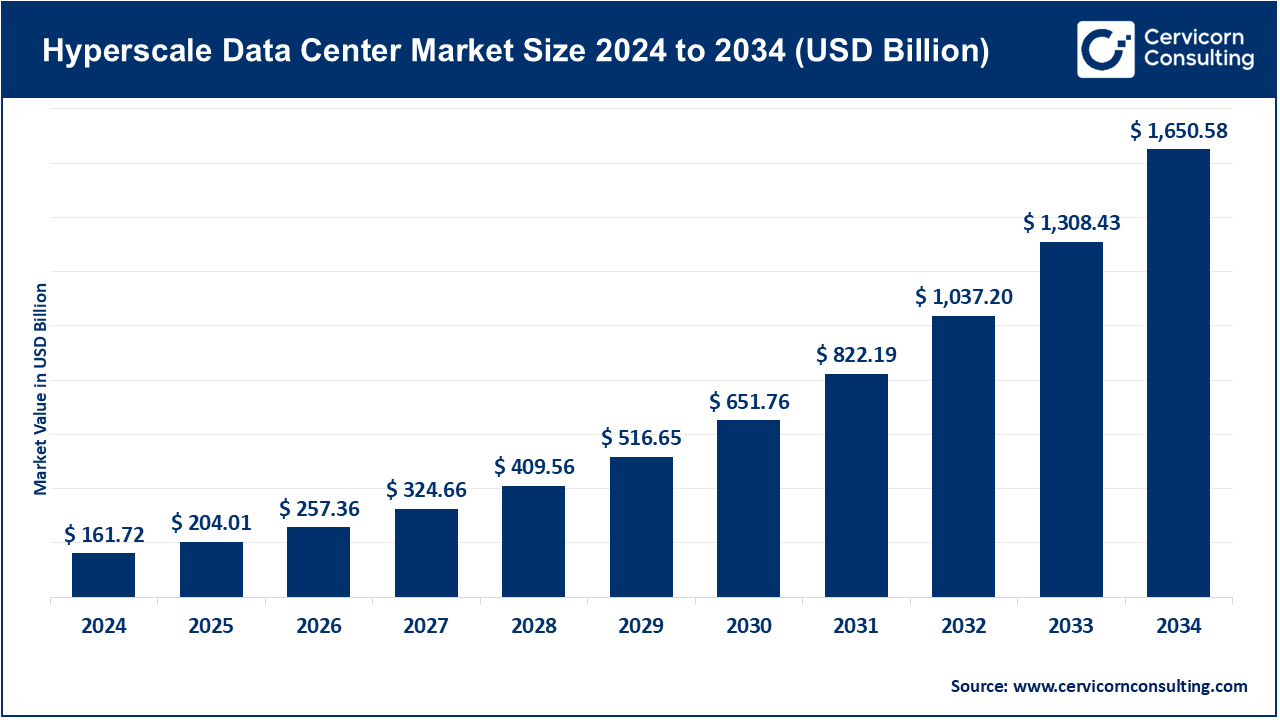
The global hyperscale data center market was valued at approximately USD 161.72 billion in 2024 and is expected to surge to nearly USD 1,650.58 billion by 2034, reflecting an impressive CAGR of 26.15% during the forecast period (2025–2034). This rapid expansion is driven by ongoing digital transformation, accelerated cloud adoption, and the massive increase in data generated from AI, IoT, and big data analytics.
Hyperscale data centers are extensive facilities engineered to house thousands of servers, storage systems, and networking equipment efficiently under one roof. With a focus on scalability, modularity, and energy efficiency, these centers enable cloud providers, social media platforms, and enterprises to manage soaring data volumes while ensuring high reliability and performance.
Get a Free Sample: https://www.cervicornconsulting.com/sample/2800
Key Market Trends
1. Growth of AI and Machine Learning Workloads
AI and machine learning are reshaping industries, creating an unprecedented need for computational power. Hyperscale data centers are adapting to support high-density GPU and accelerator architectures required for AI training and inference. Enterprises and cloud providers are increasingly investing in AI-optimized centers that provide high-performance computing, low latency, and scalable solutions.
2. Sustainability and Energy Efficiency
Sustainability has become a critical focus for hyperscale operations. Providers are optimizing power usage effectiveness (PUE), integrating renewable energy sources, and pursuing carbon-neutral operations. Technologies such as liquid cooling, waste-heat recovery, and AI-driven energy management systems are widely adopted to reduce environmental impact while maintaining peak performance.
3. Rise of Modular and Hybrid Designs
The market is moving toward modular and hybrid infrastructures, allowing quicker deployment, seamless scaling, and adaptability to diverse workloads. Prefabricated modules and hybrid solutions combining on-premises, cloud, and edge environments are becoming standard, helping operators comply with local regulations, manage costs, and maintain operational flexibility.
4. Government and Regulatory Influence
Global policies promoting renewable-powered data centers, local data storage, and digital infrastructure expansion are shaping the market. Regulatory frameworks emphasizing green energy and data sovereignty are influencing site selection and investment strategies, driving hyperscale providers to establish localized facilities in supportive regions.
5. Rapid Expansion in Asia-Pacific
While North America remains a leader in hyperscale deployments, Asia-Pacific is the fastest-growing market. Valued at USD 46.09 billion in 2024, it is projected to reach USD 470.42 billion by 2034, fueled by digitalization, industrial automation, and government initiatives for advanced data infrastructure. Key markets include China, India, Japan, and Singapore, driven by cloud adoption and 5G deployment.
Market Drivers
1. Rising Cloud Adoption
The shift toward cloud services—SaaS, IaaS, PaaS—continues to drive demand. Hyperscale data centers serve as the backbone of cloud infrastructure, supporting enterprise IT, social media, gaming, and video streaming.
2. Surge in Data Generation
Increasing data from IoT devices, connected vehicles, industrial automation, and mobile applications is boosting the need for large-scale storage and real-time processing. Hyperscale facilities offer the computational capacity to efficiently handle these volumes.
3. Advances in AI and High-Performance Computing
AI workloads demand massive parallel processing and advanced resources. Operators are investing in GPU clusters, quantum computing integration, and high-bandwidth networks to support analytics and AI applications.
4. Policy Support and Government Incentives
Governments provide tax incentives, renewable energy subsidies, and smart city initiatives that encourage investment in hyperscale facilities, enhancing digital infrastructure ecosystems.
5. Focus on Scalability and Cost Efficiency
Economies of scale enable hyperscale centers to lower operational costs per unit. Modular construction and automated operations increase efficiency, agility, and scalability.
The projected growth from USD 161.72 billion in 2024 to USD 1,650.58 billion by 2034 demonstrates the combined impact of these drivers.
Impact of Trends and Drivers
End-Use Segments:
-
Cloud providers dominate the market, followed by enterprises in finance, e-commerce, and media.
-
Private and hybrid hyperscale models are gaining traction for enhanced performance and control.
Regional Impact:
-
North America: Leading due to AWS, Google, and Microsoft.
-
Asia-Pacific: Fastest-growing region due to government support, digital transformation, and tech hubs.
-
Europe: Prioritizes sustainable, energy-efficient data centers in compliance with environmental regulations.
Application-Level Impact:
-
AI/ML, edge computing, and big data analytics are driving capacity expansion and adoption of advanced cooling and networking solutions.
Infrastructure Components:
-
Investment is increasing in high-performance servers, storage, networking systems, and smart monitoring solutions leveraging AI and IoT analytics.
Challenges and Opportunities
Challenges:
-
High capital expenditure for land, power, and cooling infrastructure.
-
Energy and environmental constraints, including carbon emissions and water usage.
-
Regulatory barriers like data localization mandates.
-
Shortage of skilled engineers and IT specialists.
Opportunities:
-
Growth in green, carbon-neutral data centers.
-
Expansion in developing markets with rising cloud adoption.
-
AI-optimized infrastructure with high-density GPU clusters.
-
Integration of hyperscale with edge facilities for low-latency processing.
Future Outlook
The hyperscale data center market is set for exponential growth with a CAGR of 26.15%, expected to exceed USD 1.65 trillion by 2034. Key future trends include:
-
AI-Driven Operations: Predictive maintenance and automated monitoring to enhance efficiency.
-
Sustainability: Achieving carbon neutrality via renewable energy and advanced cooling.
-
Regional Diversification: Strong growth in Asia-Pacific, Latin America, and the Middle East.
-
Hybrid and Edge Ecosystems: Integrating smaller edge centers for low-latency 5G and IoT applications.
-
Technological Innovation: Adoption of liquid cooling, digital twins, modular construction, and high-performance silicon solutions.
Hyperscale data centers will continue to be the backbone of the global digital economy, powering the future of cloud computing, AI, and connected infrastructure worldwide.
To Get Detailed Overview, Contact Us: https://www.cervicornconsulting.com/contact-us